

Stablecoin Weekly Pulse | Vol.18:USDGO at US$1 Billion - The Story Behind
Stablecoin supply expands, payment infrastructure investment accelerates, and USDGO crosses the US$1 billion threshold.


Vol. 18 · Data through July 23, 2026 · Approximately 10 minutes
Welcome to the Stablecoin Weekly Pulse. From Vol. 18, the series continues on OSL Insights with a concise weekly view of the data, infrastructure developments and regulatory shifts shaping stablecoin payments.
This issue covers developments through July 23, 2026, followed by a closer look at what USDGO’s US$1 billion milestone does—and does not—tell us about institutional stablecoin adoption.
1. Stablecoin & Payments: This Week in Data
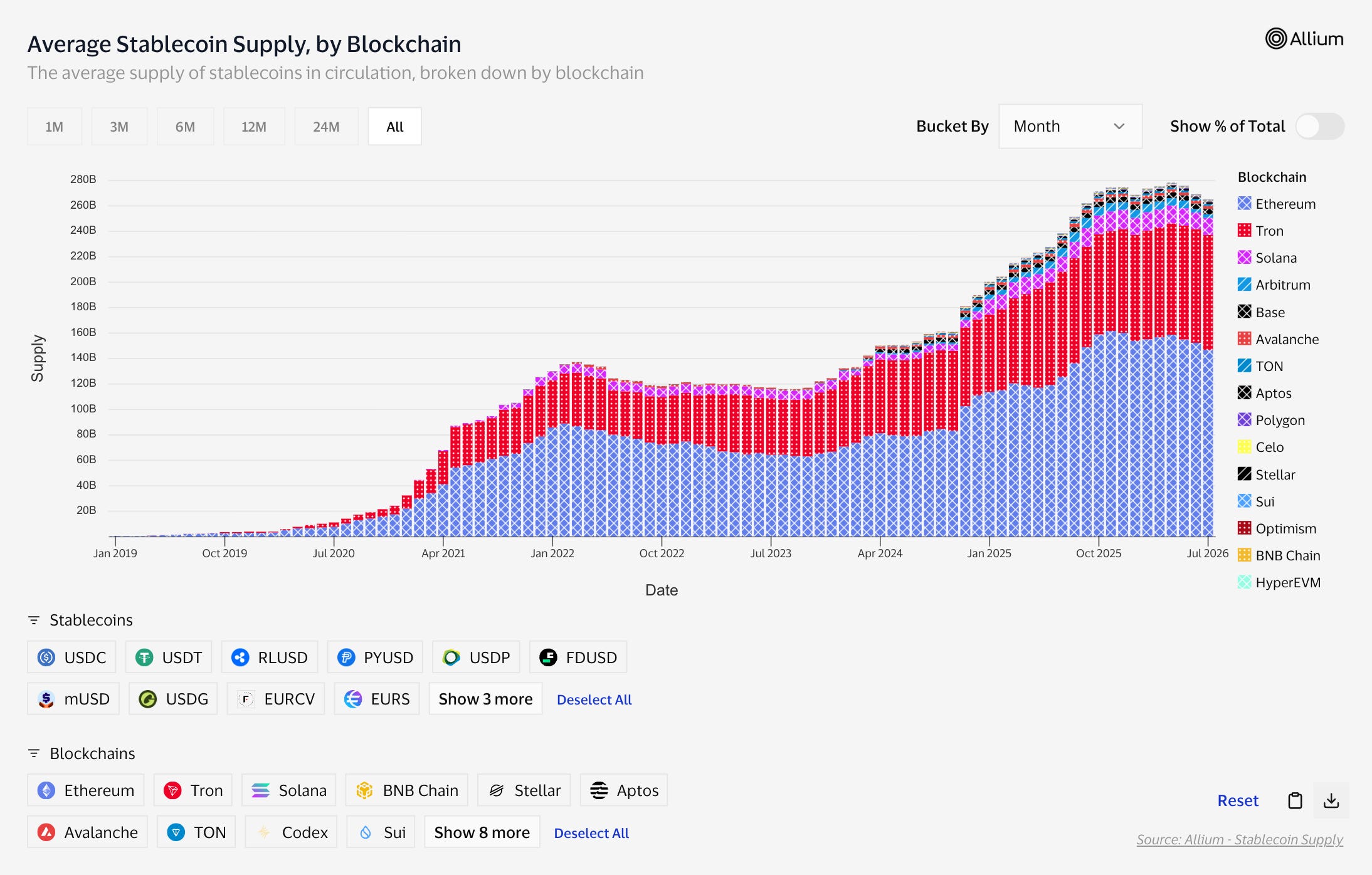
According to DefiLlama, the total market capitalization of US-dollar stablecoins across all blockchains stood at approximately US$310.983 billion as of July 23, 2026. This represented a net increase of approximately US$1.387 billion over the previous seven days, or 0.45% week over week.
Over the same period, nominal onchain stablecoin transaction volume totaled US$996.5 billion. Adjusted transaction volume was US$264.6 billion, equivalent to approximately 26.6% of nominal volume. The difference largely reflects non-end-user activity, including arbitrage, internal exchange transfers, market-making round trips and contract-to-contract transfers.
Retail-sized transactions accounted for US$1.6 billion, or approximately 0.6% of adjusted volume. There were 32.7 million retail-sized transactions, representing about 69% of the 47.3 million adjusted transactions recorded during the period. The average transaction size was approximately US$2,890 overall, compared with approximately US$49 for retail-sized transactions.
2. This Week in Stablecoin Payments and Infrastructure
1. Enterprise-Grade USDGO Surpasses US$1 Billion in Circulating Supply
On July 20, 2026, OSL Group announced that USDGO, the enterprise-grade, regulated US-dollar stablecoin operated and distributed by OSL and issued by Anchorage Digital Bank N.A., had surpassed US$1 billion in global circulating supply.
The milestone placed USDGO among the world’s six largest regulated stablecoins. It also made USDGO the largest regulated US-dollar stablecoin operated by an Asia-based stablecoin operator.
USDGO officially launched in February 2026 and is pegged 1:1 to the US dollar. Its reserves are fully supported by cash, short-term US Treasuries and other high-quality liquid assets. The underlying reserve assets include tokenised funds such as BlackRock’s BUIDL, Goldman Sachs’ STBXX and JPMorgan’s JLTXX.
USDGO is positioned as an enterprise-grade, regulated stablecoin designed for cross-border payments, institutional treasury management and other use cases combining the digital and traditional financial systems.
2. Visa Launches Enterprise Stablecoin Platform VSP
On July 22, 2026, Visa officially launched the Visa Stablecoin Platform, or VSP, an enterprise-grade stablecoin platform designed to provide unified onchain and stablecoin-management infrastructure to more than 200 million merchants, financial institutions and fintech companies worldwide.
At launch, VSP supports Open USD, or OUSD, introduced by the Open Standard Alliance. The platform is also compatible with assets including USDC and USDG.
By integrating stablecoins into Visa’s existing clearing and treasury-management networks, VSP is intended to reduce the barriers traditional businesses and financial institutions face when minting, redeeming and managing stablecoin funds.
3. Stripe-Led Consortium Proposes US$53.4 Billion Acquisition of PayPal
On July 16, 2026, digital-payments company Stripe joined private-equity firm Advent International in submitting an all-cash proposal to acquire PayPal for approximately US$53.4 billion.
The proposal valued PayPal at US$60.50 per share, representing a premium of approximately 28%. Block and several other institutions are also participating in the financing.
The proposed transaction would be one of the largest acquisitions in the payments industry in recent years. Stripe intends to combine its experience in Web3 infrastructure and stablecoins with PayPal’s extensive consumer network and its PYUSD stablecoin ecosystem, potentially reshaping the digital-payments and crypto-settlement landscape.
4. Ant International Closes US$1.2 Billion Series A
On July 21, 2026, Ant International, the payments business under Ant Group, announced the completion of a US$1.2 billion Series A funding round.
The round included participation from Ant Group, Alibaba and several leading international institutional investors.
The funding reflects accelerating capital deployment across cross-border payments and fintech. Ant International said it would focus its expansion on Southeast Asia, the Middle East and Latin America, increasing investment in cross-border payments, global accounts and inclusive financial-technology services to support merchant growth.
5. GENIUS Act Implementation Rules Still Pending One Year After Signing
July 18, 2026 marked the first anniversary of the signing of the US GENIUS Act.
However, significant disagreements remain among six major regulatory authorities—including the Federal Reserve and the US Treasury—as well as traditional banks and industry lobbying groups. The debate centres on how competing interests should be balanced and how the Act’s anti-money-laundering provisions should be implemented.
Regulators did not deliver the final implementation rules by the statutory one-year deadline, resulting in a further delay.
The delay has pushed the broader rulemaking timetable back to no earlier than the first quarter of 2027 and could extend the final mandatory effective date to August 2027.
Applications for permitted payment stablecoin issuer status are currently on hold. Meanwhile, continued pressure from the White House and Congress is further compressing the time available to stablecoin issuers for onchain technology upgrades and compliance audits during the second half of 2026.
3. Analyst Deep Dive
USDGO’s New Starting Point: What Does Surpassing US$1 Billion Really Prove?
For Asian and emerging-market businesses long troubled by local currency volatility and inadequate banking coverage, USDGO offers an answer: a 1:1 US dollar peg that removes exchange-rate loss, 24/7 real-time conversion so funds never have to wait on a settlement window, and — for the funds that businesses have traditionally been forced to pre-position and leave sitting idle ahead of cross-border settlement — the option to receive ecosystem participation rewards by connecting to the USDGO ecosystem, reducing the opportunity cost of having that capital locked up.
Stablecoins have long been understood by most people as little more than “a bridge for trading virtual assets” — but that perception is now being rewritten by the market. In July 2026, USDGO, the enterprise-grade, compliant stablecoin operated and distributed by OSL Group, surpassed US$1 billion in circulation, placing it among the top six compliant stablecoins globally, and making it the largest US dollar-backed, compliant stablecoin operated by any Asia-based operator.
Crossing the US$1 billion threshold didn’t happen by chance. In December 2025, OSL Group announced its plan to launch USDGO, with Anchorage Digital serving as issuer and OSL as brand operator and distributor — a structure that anchored the product to bank-grade compliance standards from the outset. Since its official launch in February 2026, USDGO’s reserve structure has continued to expand, with BlackRock’s BUIDL, Goldman Sachs’ STBXX, and JPMorgan’s JLTXX joining in succession, building a reserve system jointly backed by some of the world’s leading asset managers.
In terms of circulation, USDGO grew from US$100 million to US$1 billion in just three months — a pace of validation rarely seen over the growth cycle of financial infrastructure products. As Jason Liu, Head of USDGO at OSL Group, put it:
“Growing from US$100 million to US$1 billion is more than a simple increase in scale for USDGO; it marks a leap to a new tier of liquidity.”
Surpassing US$1 billion in circulation means USDGO now has the liquidity depth to support large-value, institutional-grade payments. But the more important question is this: what does this growth actually reflect?
The Only Asian Player in the Global Top Six: Closer to the Real Pain Points of Emerging-Market Clients
Local currency volatility, insufficient banking network coverage, and cross-border settlement bound to fixed clearing windows — these three frictions are part of daily life for businesses and financial institutions operating across Southeast Asian trade corridors, Latin American payment channels, and African remittance networks. Yet for years, the compliant stablecoin space has been dominated largely by US-based institutions, whose systems were not originally designed with these emerging-market realities in mind — leaving behind a structural gap.
USDGO’s rise into the global top tier goes some way toward filling that gap. As the only Asia-based operator currently in this tier, its client base, business network, and operating DNA are naturally closer to the realities facing emerging-market institutions. Seen from this angle, USDGO’s presence in this ranking carries particular significance.
First, this closeness to the market makes it easier for USDGO to target the specific pain points of these institutions when building out its ecosystem and distribution channels, and to better understand the needs of businesses that have long dealt with currency volatility and gaps in banking coverage.
Second, alongside this market understanding, USDGO was designed from the ground up as an enterprise payment tool, built on bank-grade compliance and security together with institutional-grade technology and channel infrastructure.
This combination — an operating DNA rooted in emerging-market pain points, paired with the security and technical assurance of enterprise-grade payments — is what has earned USDGO a standout position near the top of the global stablecoin rankings, particularly among the small number of compliant stablecoins.
Capital Management in Three Stages: From Zero-Friction Conversion to Ecosystem Rewards
One of the advantages stablecoins hold over traditional payment methods is that blockchain technology allows them to bypass layers of intermediaries, achieving greater efficiency at lower cost. Yet most stablecoins on the market share a common pain point: the hidden cost embedded in the spread between fiat currency and the stablecoin itself. That spread may look minor on its own, but when scaled up across institutional-level corporate payments and treasury turnover, it becomes a cost too large for business decision-makers to ignore when evaluating whether to adopt a given stablecoin. Addressing this is another reason USDGO has been able to win market acceptance and scale so quickly.
First, USDGO is pegged 1:1 to the US dollar, so conversion and redemption carry no exchange-rate loss.
USDGO is not only backed 1:1 by US dollar reserves — whenever the market genuinely needs liquidity, it also offers clients efficient, slippage-free 1:1 conversion between USDGO and US dollars. More importantly, unlike many mainstream stablecoins, USDGO charges no additional redemption fees on top of zero-slippage fiat conversion, achieving truly frictionless on-chain asset flow across conversion, subscription, and redemption.
Second, USDGO enables round-the-clock, real-time conversion, so funds never have to wait on a settlement window.
Traditional fiat clearing depends on fixed banking windows, with fund transfers often held up by time zones or business days. USDGO’s conversion and settlement capabilities, by contrast, operate 24/7 — whenever a business has a liquidity need, it can complete the conversion immediately, without having its cash flow held hostage by a clearing window. This, too, has been a key driver behind USDGO’s market acceptance and rapid growth.
At the same time, in-transit funds can also receive ecosystem rewards, freeing businesses from the opportunity cost of locked-up capital.
In building out its compliant stablecoin ecosystem, USDGO has placed particular emphasis on supporting its partners. Take in-transit fund management as an example: under the traditional model, businesses covering the time gap in cross-border payments have typically had to pre-position a lump sum of fiat currency across multiple markets as working capital — funds that sit idle until they are actually put to use.
USDGO converts this kind of capital, which would otherwise have to be locked up in advance, into an on-chain US dollar asset that can be deployed on demand at any time. Businesses no longer need to pre-fund large sums; instead, they can convert exactly what they need, exactly when a transaction occurs. This alone lowers a business’s cost of capital being tied up — and businesses may be further rewarded by choosing to bring their in-transit funds into the ecosystem, further reducing the opportunity cost that traditional businesses bear when allocating capital.
Across cross-border payments, fiat on- and off-ramping, and institutional fund flows, USDGO has already built partnerships with a number of experienced payment-industry participants whose coverage spans both emerging and developed markets. On the infrastructure and institutional custody side, it continues to work closely with several leading technology service providers.
As the operator and distributor, OSL Group committed an initial US$20 million to ecosystem rewards, and continues to offer participation rewards to clients using USDGO for transactions and payments — all aimed at working alongside its partners to drive the adoption of USDGO in enterprise settlement and cross-border payments. This ecosystem support allows institutions, such as multinational manufacturers and supply-chain treasury managers — the kind of businesses considering stablecoins while grappling with both capital erosion and the opportunity cost of tied-up working capital — to genuinely cut costs and improve efficiency, while also receiving further ecosystem rewards by expanding their real-world use cases.
It is precisely these connections spread across payments, trading, and custody that give USDGO the underlying capability to support institutional-scale, large-value payments. Scale is the outcome; ecosystem support is what gives the market confidence to adopt it in the first place.
Expanding Use Cases, Reinforced by Trust
USDGO’s leap to a new tier of liquidity also reflects the scale of institutional demand — and room for exploration — that emerging markets hold for compliant stablecoins. That demand isn’t confined to a handful of fixed use cases; it continues to be discovered, validated, and extended as USDGO takes root across different markets and client types. The use cases that have emerged so far include, but are not limited to:
Institutional fund transfers and treasury management — helping multinational corporations and financial institutions significantly improve turnover efficiency in cross-border fund allocation;
Digitally native use cases such as interactive entertainment — a unified on-chain US dollar settlement account to handle high-frequency, high-loss, and currency-fragmented deposit and payment needs;
Fintech and payment service platforms — round-the-clock, low-cost international on/off-ramp channels and on-chain US dollar liquidity support;
In-transit fund support and trade finance — serving as an alternative to fiat settlement that provides US dollar liquidity support, fully traceable on-chain.
These use cases have been among the first to gain traction, because they sit at the points of greatest friction in emerging-market cross-border fund flows — local currency volatility, gaps in banking coverage, and fixed clearing windows are all amplified in these scenarios. But these are only the use cases validated so far within USDGO’s scope for exploration, not its boundaries. The true value of a compliant stablecoin lies in its versatility — from cross-border fund flows to high-frequency daily consumption, virtually any use case could, in theory, become one of its applications.
Over the past year, the maturing of global stablecoin regulatory frameworks — including the signing of the GENIUS Act in the United States — has been turning “compliance” from a nice-to-have into a baseline requirement for institutional clients choosing a stablecoin. As regulatory uncertainty continues to clear, institutional clients’ stance on stablecoins has been shifting from “wait and see” to “evaluate for adoption,” offering a timely window for a product like USDGO, with its bank-grade compliance foundation.
USDGO’s own underlying structure has continued to build on that trust throughout this window of opportunity. It is issued by Anchorage Digital Bank N.A., the first federally chartered crypto bank in the United States, and operated and distributed by OSL, a Hong Kong-listed company licensed across multiple jurisdictions worldwide. Its reserves are backed 1:1 by cash and short-term US Treasuries, with underlying holdings that include tokenized funds from three of the world’s top financial institutions — BlackRock, Goldman Sachs, and JPMorgan. Each of these mainstream, established institutions joining sends the market the same signal: this system is worth being used and adopted at a greater scale.
Emerging markets have long lacked an on-chain settlement tool that is truly compliant, trustworthy, and offers both high liquidity and easy convertibility. This is the gap USDGO has set out to fill. The US$1 billion milestone doesn’t validate the success of any single use case — it validates that this underlying capability is now ready to be adopted more broadly across the market. As for which new use cases will drive the next wave of demand, that answer is still unfolding. And perhaps that’s the real meaning behind what OSL has said: surpassing US$1 billion is not an endpoint, but a new starting point for USDGO to pursue broader opportunities in the institutional market.
This content is for general information only and does not constitute investment, legal, tax or other professional advice, or an offer or solicitation; please read the full Disclaimer and Disclosure.
Want to catch up? Browse all previous issues of the Stablecoin Weekly Pulse in our LinkedIn newsletter archive.